Choosing training data repairs
Does searching for interacting data repairs improve a retrained model enough to justify the extra work?
Method
Keep the input features and ridge penalty (the cost assigned to large model coefficients) fixed. Evaluate finite row deletions or verified target corrections, select repairs within an edit budget, and send one proposal to a separate validation check.
Retrain accepted repairs from scratch with scikit-learn and independently check the resulting model. Digits uses official writer-separated test data; Airfoil holds out physical-condition groups. The confirmation retains 2,040 before/after outcomes.
How repair quality is scored
U is the gain from a repair; E is held-out model error. Positive values mean the repaired model has lower error. Selection and guard checks use separate data from the final evaluation.
Results
| Primary comparison | Greedy recovery | Beam recovery |
|---|---|---|
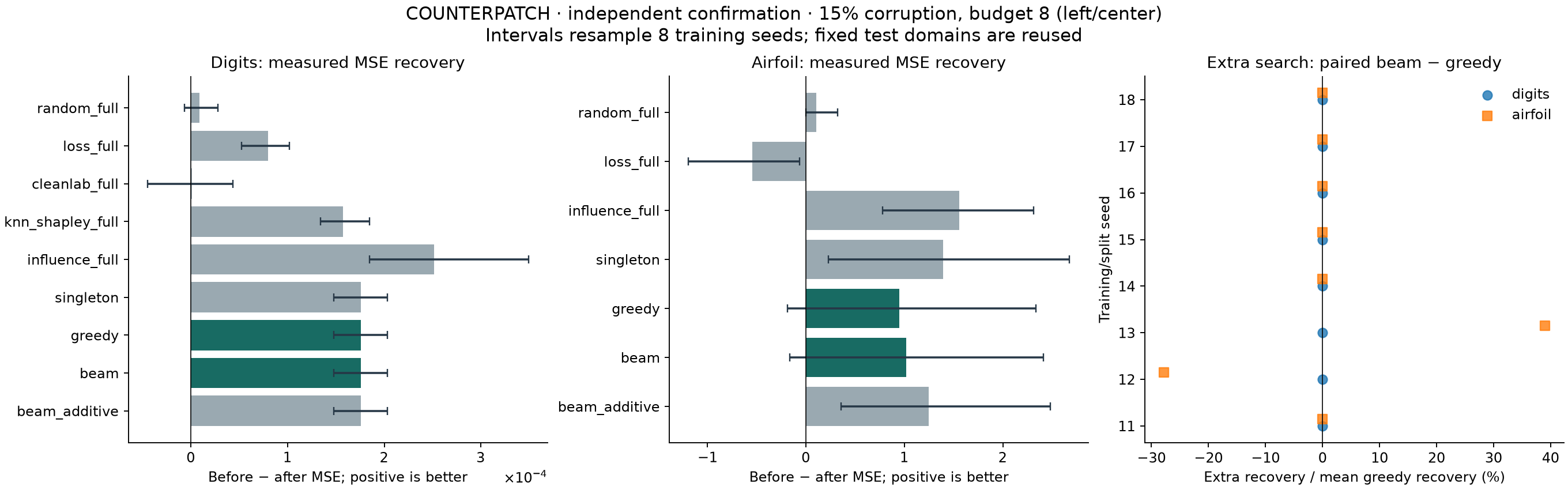
| Digits score MSE | 0.000158129 | 0.000158129 |
| Airfoil MSE, dB² | 1.241507 | 1.258849 |
MSE means mean squared error. Recovery is the reduction in error after repair, so larger values are better. The Airfoil gain is 1.4%, with a paired interval spanning harm and benefit. The frozen target required at least 10% extra recovery on both tasks; it fails. Audited-label optimization also ties greedy.
Interpretation
Use exact greedy as the prospectively chosen default, or inspect the conventional full-data influence alternative that recovers more mean error in these settings. The added beam and label-search machinery does not demonstrate better repair quality.
Limitations
- The update identities apply to fixed-feature ridge models. Changing preprocessing, normalization, or the model family invalidates that contract.
- The guard still accepts some harmful repairs under domain shift. Ridge-selected repairs also degrade the Airfoil random-forest transfer result.
- Fast exact counterfactual calculations are an engineering benefit, not evidence of a novel selector or general reliability restoration.
Paper & sources
COUNTERPATCH: Exact Data-Repair Counterfactuals and a Negative Result for Added Search
Cite this study
@misc{abdulhadi2024counterpatch,
  author = {Nazeeh Abdul-Hadi},
  title = {COUNTERPATCH: Exact Data-Repair Counterfactuals and a Negative Result for Added Search},
  year = {2024},
  url = {https://nazeeh111.github.io/research/counterpatch/}
}