Camera–laser change detection
Does learning sensor quality improve movement detection over simple camera–laser fusion?
Method
Original rendered surveys and independently raycast laser observations measure a common surface-normal motion component. Two learned residual-scale models weight the sensors while keeping dependence and shared-reference uncertainty explicit.
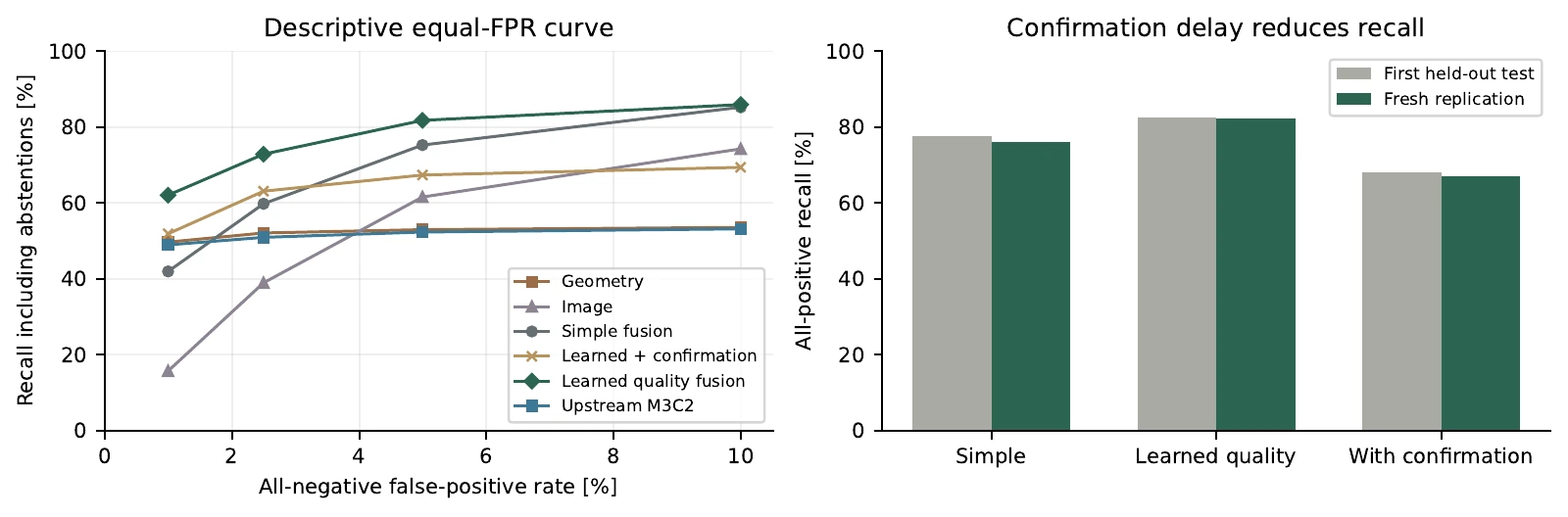
A temporal confirmation rule misses early movement and is removed. The simpler remaining method is evaluated on sixteen fresh procedural sites with unchanged weights and calibration thresholds.
Results
| Fresh simulated sites | Learned fusion | Simple fusion |
|---|---|---|
| Recall, including abstentions | 82.33% | 75.93% |
| False-positive rate | 5.60% | 5.42% |
| Observation coverage | 95.13% | 95.13% |
| Root-mean-square motion error | 20.17 mm | 25.17 mm |
Interpretation
The fresh-site recall gain is 6.39 percentage points, with a paired site-bootstrap interval of 4.28–8.86 points. This supports learned quality weighting on the simulated task, while false-alarm equality is not established.
Limitations
- This is the preserved simulation study, not field validation or a rockfall forecast.
- A later realism and false-positive revision was unfinished at the saved snapshot. Its proposed changes are not treated as verified results.
Paper & sources
cragshift: Quality-aware Camera–Laser Monitoring with an Auditable Simulated Rock-slope Benchmark
Cite this study
@misc{abdulhadi2026cragshift,
  author = {Nazeeh Abdul-Hadi},
  title = {cragshift: Quality-aware Camera–Laser Monitoring with an Auditable Simulated Rock-slope Benchmark},
  year = {2026},
  url = {https://nazeeh111.github.io/research/cragshift/}
}