Contact-gradient accuracy
Does agreement across smaller timesteps and parameter changes make a simulated contact derivative reliable?
Method
A self-contained rigid-body engine records trajectories, contact regimes, solver diagnostics, and numerical sensitivities. The proposed gate combines perturbation and timestep checks before accepting a derivative.
An independent analytic impact reference tests accuracy. An established event-time implementation provides a stronger baseline. Separate studies examine measured bouncing-ball trajectories, external CPU engines, and inverse identification costs.
Results
| Check | Result |
|---|---|
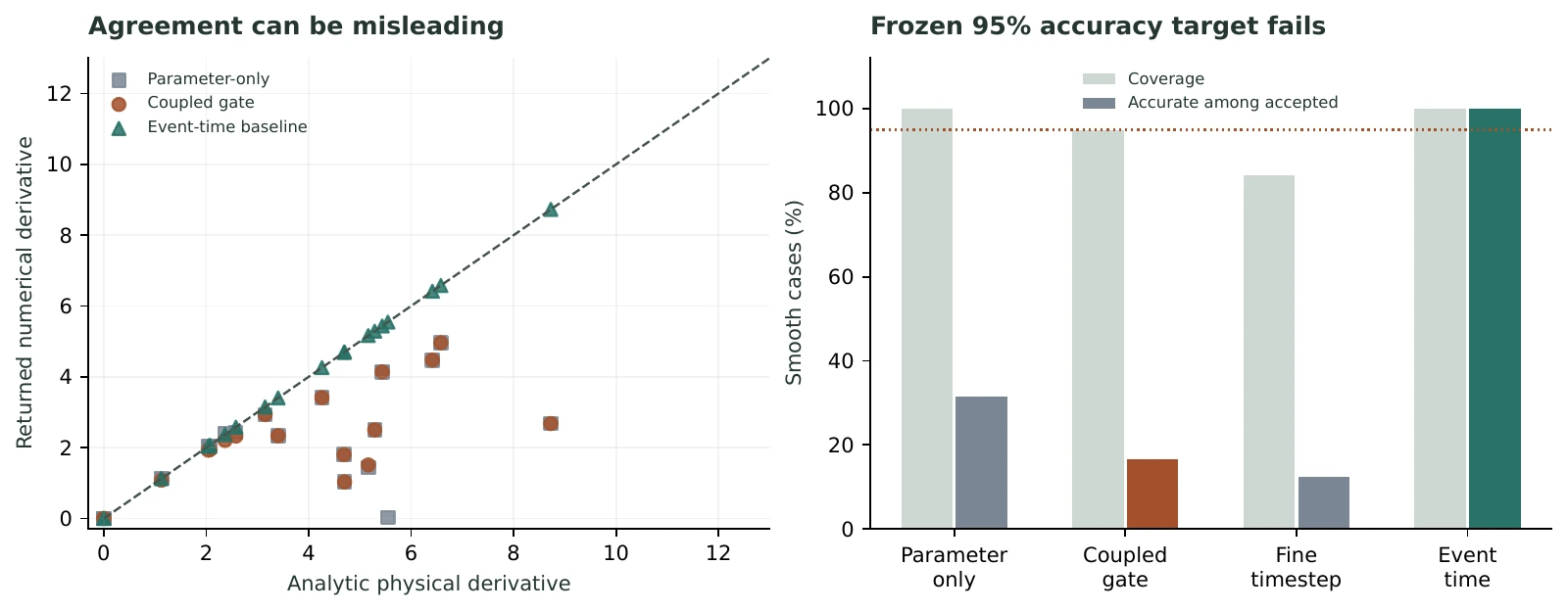
| Proposed derivative gate | 18 of 19 smooth cases accepted; only 3 accepted derivatives meet the accuracy target |
| Event-time baseline | All 19 supported smooth cases pass; grazing input is refused |
| Measured-data transfer | 5.474 mm pooled root-mean-square vertical error across three untouched trials after one-trial calibration |
| Identification study | The proposed controller fails the two-family cost target |
Interpretation
Refinement agreement can converge on the wrong contact derivative. Use the event-time reference within its supported isolated-impact domain; treat the proposed gate as an empirical check, not a certificate.
Limitations
- The engine is a CPU reference with a bounded collision and constraint set. General engine superiority is not established.
- The event-time baseline does not cover resting contact, friction, joints, or simultaneous impacts.
- The bouncing-ball transfer result is a separate forward-prediction check and does not validate the rejected gradient gate.
Paper & sources
inertiaforge: Auditing Contact Dynamics and the Limits of Gradient Agreement
Cite this study
@misc{abdulhadi2026inertiaforge,
  author = {Nazeeh Abdul-Hadi},
  title = {inertiaforge: Auditing Contact Dynamics and the Limits of Gradient Agreement},
  year = {2026},
  url = {https://nazeeh111.github.io/research/inertiaforge/}
}