Stopping rules for heat diffusion
Can spectral moments reduce the work required to approximate a sparse diffusion calculation accurately?
Method
Approximate the action of a matrix exponential using Chebyshev terms. Moment information supplies bounds on omitted terms; a partitioning rule chooses a tail bound.
Compare the complete calculation with ordinary Chebyshev, SciPy Taylor, restarted Hermitian Krylov, and CRAM16. A separately frozen continuation adds a fixed-envelope evaluator and a faster exact dyadic checker.
Computed quantity
A is the diffusion operator, b is the initial vector, and t is elapsed diffusion time. The algorithm computes the resulting vector without forming the full matrix exponential.
Results
| Study | Measured result |
|---|---|
| Original product savings | 0–8.71%; below the frozen 25% target |
| Original median end-to-end ratio | 0.995 against the fastest measured applicable baseline |
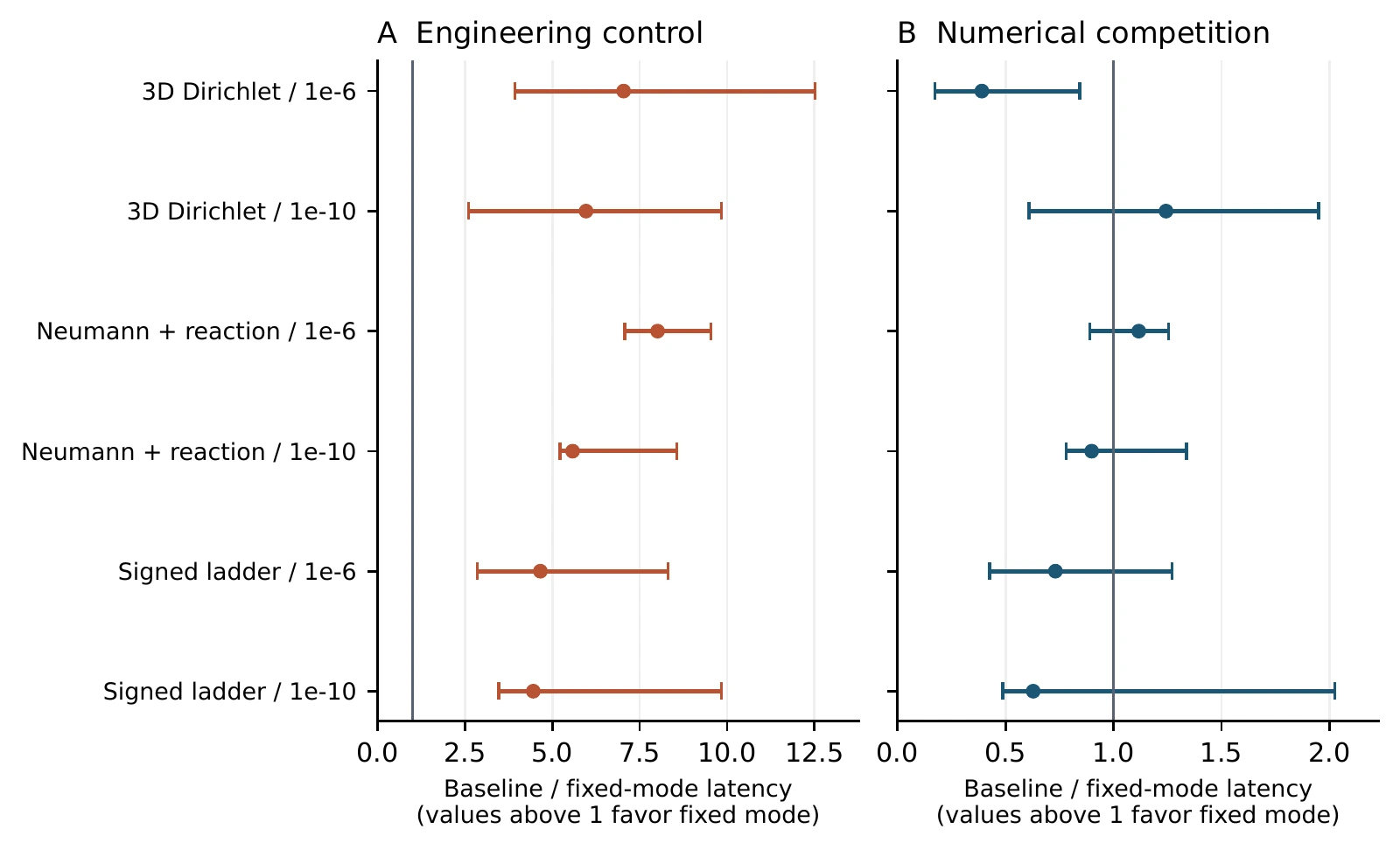
| Continuation vs unchanged v1 | 4.46–8.01× faster, primarily through checker engineering |
| Reference checks | 385 original plus 270 continuation timed outputs pass |
Interpretation
The continuation improves the implementation. It does not establish a generally better numerical algorithm: comparisons against the numerical baselines remain mixed, and the original scientific targets fail.
Limitations
- The core polynomial identities have established precedents; application novelty is unresolved.
- A floating-point counterexample narrows the supported range. The mathematical bound is not a complete floating-point certificate.
Paper & sources
Moment-Weighted Fourier Envelopes for Heat Actions: A Reproducible Algorithm-Discovery Study
Cite this study
@misc{abdulhadi2025manifold,
  author = {Nazeeh Abdul-Hadi},
  title = {Moment-Weighted Fourier Envelopes for Heat Actions: A Reproducible Algorithm-Discovery Study},
  year = {2025},
  url = {https://nazeeh111.github.io/research/manifold/}
}