Neutrino frequency bounds
Which growing frequencies are compatible with limited information about a neutrino angular distribution?
Method
Treat each species as a positive angular measure constrained by supplied moments. In the restricted axial model, the dispersion equations reduce to a complex Stieltjes value, and classical moment theory turns compatibility into a disk-intersection problem.
Exact certificates check individual frequency decisions. Further analysis derives sharp growth envelopes, including a finite-wave-number result for equal supplied second moments and a separate nonaxial result with common isotropic full moments.
Results
| Check | Result |
|---|---|
| Planned frequency decisions | 504 independently checked: 72 possible and 432 impossible |
| Continuous solver comparison | 722 cases; no certified disagreement, and no general end-to-end speed advantage |
| Published counter-flux test | All eight reproduced growing closure modes remain compatible |
| Practical usefulness | Not established by the closure-mode tests |
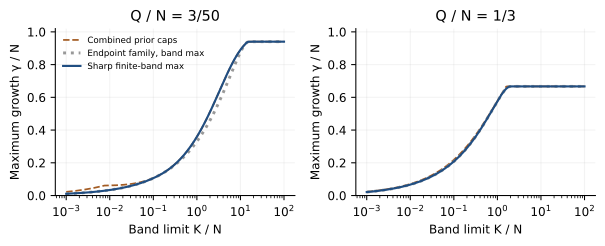
Interpretation
The method bounds what the moment information permits. A compatible unstable frequency need not occur in the actual physical background, and different frequencies may need different angular completions.
Limitations
- The models are local and collisionless. The axial and nonaxial results have different moment assumptions.
- The later nonaxial extension has exact algebraic checks; the earlier independent verification covers the axial results.
- Scientific priority and practical astrophysical benefit remain unestablished.
Paper & sources
Exact Frequency Uncertainty from Neutrino Angular Moments
Cite this study
@misc{abdulhadi2026neutrinopositivemoments,
  author = {Nazeeh Abdul-Hadi},
  title = {Exact Frequency Uncertainty from Neutrino Angular Moments},
  year = {2026},
  url = {https://nazeeh111.github.io/research/neutrino-positive-moments/}
}