Quantum records: separate and pooled decisions
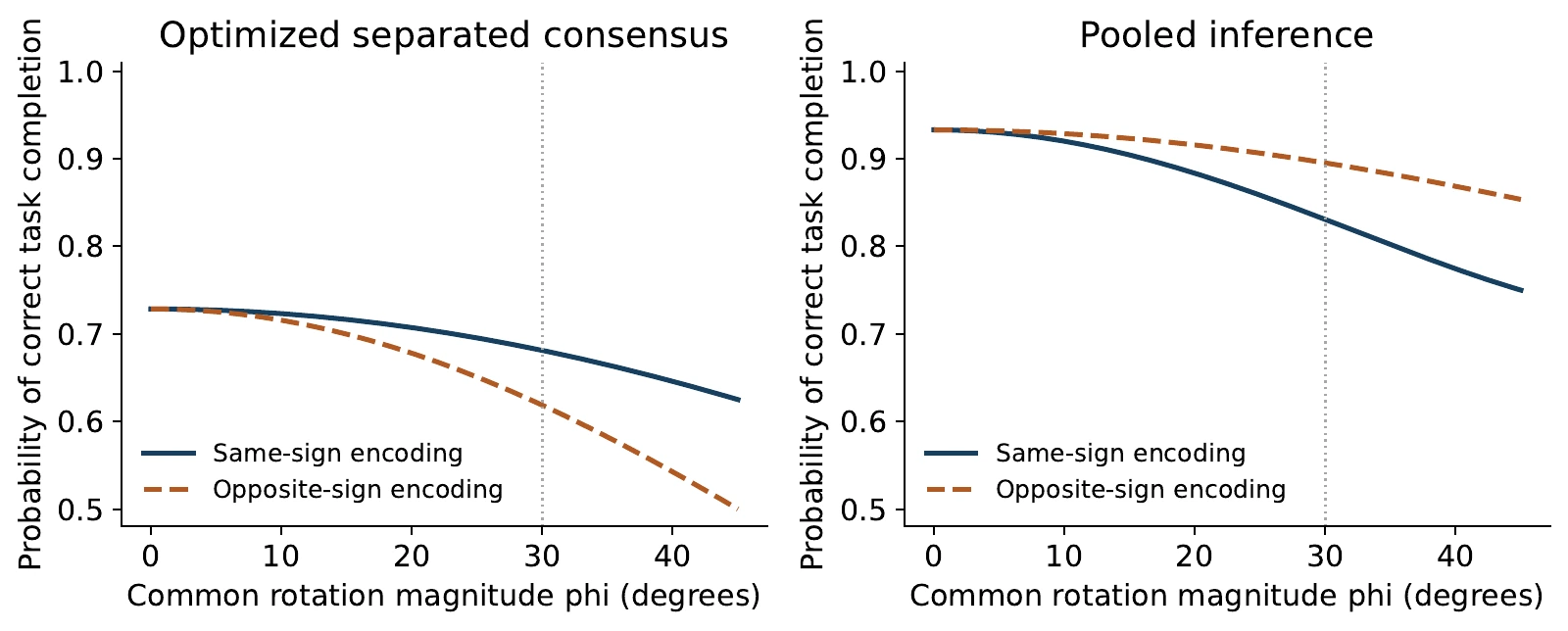
Does the same encoding best support observers deciding separately and observers combining their quantum records?
Method
Quantum Darwinism follow-up. This study developed from the One-Shot Quantum Darwinism project and focuses on the encoding-reversal result.
Two pure-product encodings pass through one common random-rotation channel. Their complete local conditional states are held fixed, so neither encoding gains an advantage from better individual records.
The analysis classifies the supported encoders and optimizes separate all-correct decisions over all local binary measurements. It then compares that result with pooled inference. A second construction uses coherent records under common Gaussian displacement.
Results
| Result | What is established |
|---|---|
| Encoder classification | Two classes under the prescribed pure-input and fixed-frame assumptions |
| Exact benchmark | 1/16 gap in optimized all-correct consensus |
| Pooled inference | The opposite class is optimal; adaptive local measurements with communication attain the pooled optimum |
| Coherent-state extension | Rational bounds establish a reversal without truncating the photon-number basis |
Interpretation
The preferred encoding depends on the decision task. Identical individual records can conceal different joint information under correlated noise.
Limitations
- The generic possibility of opposite rankings already exists classically. The contribution is the solved, constrained quantum family.
- The encoder, frame, and noise assumptions are part of the result. Historical priority and experimental validation remain open.
Paper & sources
Opposite Encoding Preferences for Quantum-Record Consensus and Pooled Inference
Cite this study
@misc{abdulhadi2025quantumrecords,
  author = {Nazeeh Abdul-Hadi},
  title = {Opposite Encoding Preferences for Quantum-Record Consensus and Pooled Inference},
  year = {2025},
  url = {https://nazeeh111.github.io/research/quantum-records/}
}