RevertLab
Pairs trading under relationship failure
Does valuing convergence and relationship failure together improve trading decisions after both-leg costs?
Method
A forward-only model compares stable mean reversion with a persistent rival. It values a fixed convergence policy using actual holdings, delayed liquidation, borrowing, and execution costs.
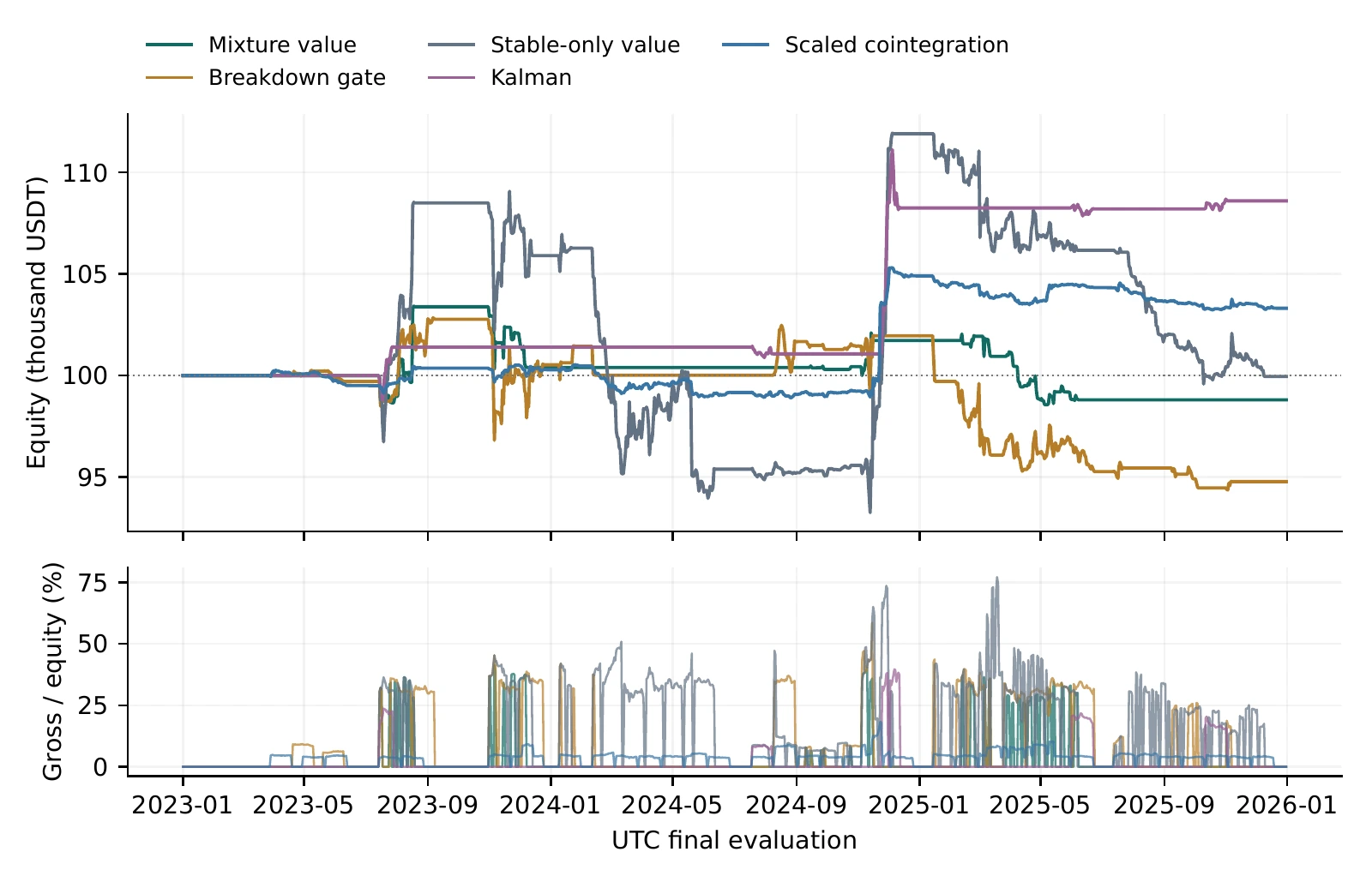
The six-asset, three-pair crypto study uses formation-only selection, development through 2022, and a reserved 2023–2025 evaluation. A separate accountant reconstructs both legs and every cashflow.
Results
| Reserved evaluation | Result |
|---|---|
| Proposed-rule return on deposited capital | −1.20% |
| Maximum drawdown | 4.70% |
| Average gross exposure | 2.72% |
| Improvement over the selected gate | Uncertainty interval includes harm; economic advantage unestablished |
Interpretation
The integrated rule does not establish an advantage. Simpler comparators perform better, and known-process tests show that higher volatility can be mistaken for relationship failure.
Limitations
- Borrow availability and execution are simulated assumptions. The study does not establish historical short availability or achievable venue fills.
- The result is specific to this chronological asset universe and protocol. Positive returns in a comparator do not establish an investable edge.
Paper & sources
RevertLab: Cost-aware Continuation under Rival Spread Dynamics
Cite this study
@misc{abdulhadi2026revertlab,
  author = {Nazeeh Abdul-Hadi},
  title = {RevertLab: Cost-aware Continuation under Rival Spread Dynamics},
  year = {2026},
  url = {https://nazeeh111.github.io/research/revertlab/}
}