Choosing measurements for positive spectra
Can reusing adversarial spectra make minimax measurement selection cheaper, and does that improve acquisition?
Method
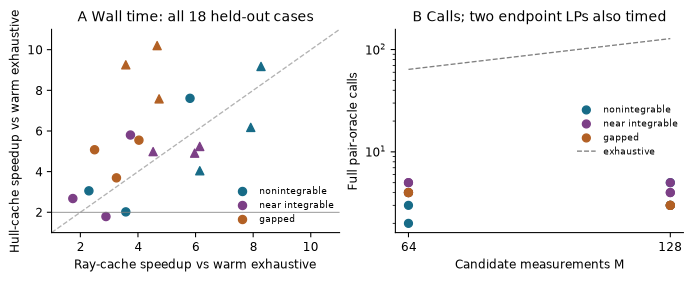
A shared witness cache bounds candidate noisy-correlator measurements before invoking a full optimization oracle. Compare the finite-menu choice with a persistent, warm-started HiGHS baseline and a simpler ray cache.
A separate physical acquisition study compares uncertainty reduction. A corrective follow-up makes selection and reported intervals use the same endpoint-cell model, then checks the unchanged target on fresh cases.
Results
| Study | Result |
|---|---|
| Original finite-menu selection | 5.16× median speedup across 18 held-out menus |
| Original acquisition target | 4/9 cases reached vs 6/9 for conventional target-specific design |
| Corrective follow-up | All five policies miss the target on all nine new cases |
| Follow-up diagnosis | Coarse-cell ambiguity remains above target even with all available observations |
Interpretation
The original computation is faster on the measured menus. That does not establish better scientific acquisition. The corrective experiment also exposes a resolution bottleneck that makes its ranking comparison inconclusive.
Limitations
- Optimal recovery, positivity bounds, and oracle caching have established precedents. Priority for this specialization is unresolved.
- Independent physical per-time sampling costs are not established. The two reports retain separate models, timings, and outcomes.
Paper & sources
Projected Witness Reuse for Positive Spectral Experiment Design
Cite this study
@misc{abdulhadi2025spectralambiguity,
  author = {Nazeeh Abdul-Hadi},
  title = {Projected Witness Reuse for Positive Spectral Experiment Design},
  year = {2025},
  url = {https://nazeeh111.github.io/research/spectral-ambiguity/}
}