Rare-loss sampling and missed failure modes
Can a structured rare-event sampler improve efficiency while keeping uncertainty meaningful when a catastrophic mode is missed?
Method
For supported maximum-of-quadratic losses, a proved union of halfspaces covers the failure regions. Exact conditional sampling and integration of one Gaussian direction produce bounded probability contributions.
The frozen evaluation contains 17,280 complete algorithm runs across eight known-truth problems and fifteen methods or variants. A separate randomized-order timing study checks the primary efficiency conclusion.
Results
| Comparison | Result |
|---|---|
| Primary mean-squared error × runtime ratio vs conditional scrambled Sobol | 38.79; 95% interval 26.48–57.32; lower is better |
| Separate timing confirmation | 37.37; same unfavorable conclusion |
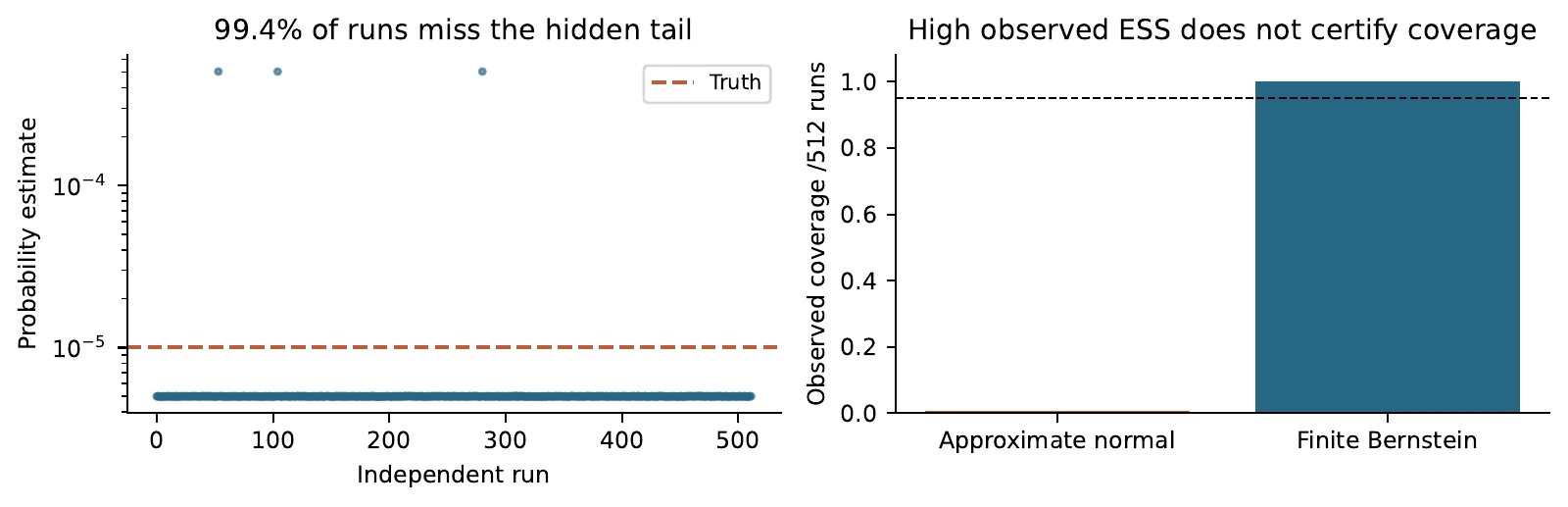
| Omitted-mode normal-interval coverage | 3 of 512 runs |
| Primary finite-bound coverage | 128 of 128 runs; coverage-rate interval 0.9716–1 |
Interpretation
Conditioning improves the corresponding raw union sampler, but the strongest conditional quasi-Monte Carlo comparator wins the primary task. Large observed effective sample sizes do not protect an ordinary interval from a completely missed mode.
Limitations
- The derivation uses established union sampling, conditional expectation, and concentration bounds. An original general estimator is not established.
- The guarantees depend on the supported model and failure cover. The historical FX sensitivity check is separate from estimator efficiency.
Paper & sources
TAILSENTRY: Structure-Certified Conditional Union Sampling for Rare Losses
Cite this study
@misc{abdulhadi2025tailsentry,
  author = {Nazeeh Abdul-Hadi},
  title = {TAILSENTRY: Structure-Certified Conditional Union Sampling for Rare Losses},
  year = {2025},
  url = {https://nazeeh111.github.io/research/tailsentry/}
}