Capsulith
Run a prepared native image component in the browser, reopen its initialized pixel allocation in a fresh worker, and inspect the result.
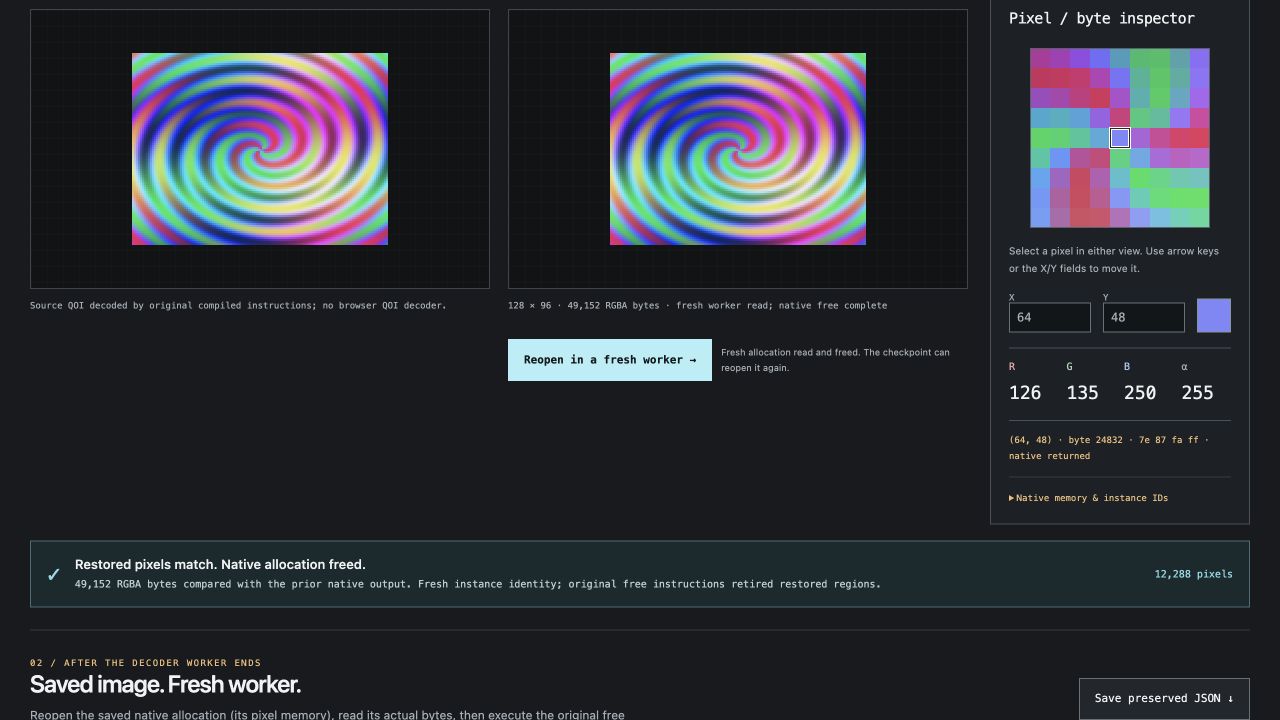
Scope of this case
This is one observed prepared Orbit example. The workbench comparison is not an independent native oracle, a new codec, universal binary compatibility or a security-isolation proof. The exact source revision of this retained screenshot was not recorded.
The problem
A native component can depend on initialized state and owned memory, not just a function address. Reusing it requires preserving that state and an explicit calling contract.
The mechanism
Capsulith packages selected ARM64 functions with calling contracts and owned memory. The image workbench runs the prepared QOI decoder through native-code emulation, retains the decoded allocation, then reopens it in a fresh worker. Pixel inspection and native free expose the memory lifecycle instead of hiding it behind a static preview.
The observed result
The November 16 browser run reported that 49,152 restored RGBA bytes matched the prior native output and that native free completed. Pixel (64, 48) read RGBA (126, 135, 250, 255).
Foundations
QOI is by Dominic Szablewski and contributors under MIT. Native emulation uses Unicorn.js and Unicorn. Capsulith’s runtime is GPL-2.0-only; the project retains the complete third-party notices.
Inspect the details
Choose Load & run example in the image workbench, then Reopen in a fresh worker. The prepared case does not require an account, original application or compiler in the browser.
The screenshot preserves the earlier prepared-QOI workflow. Newer PNG/QOI controls are documented in the repository; they are not retroactively claimed as part of this retained capture.