InstrumentZero
Create a seeded ringdown, compare processing placements, and inspect the resonance and damping estimates alongside the signal and its assumptions.
Scope of this case
This is seeded simulation and a same-input numerical reference, not a physical sensor capture or independently measured resonance. The declared resolution/clock envelope is not a validated confidence interval or a coverage guarantee.
The problem
A frequency or damping estimate is hard to assess without the input signal, processing path and calibration assumptions. Agreement with a reference calculation also needs to be distinguished from a physical measurement.
The mechanism
InstrumentZero turns supported experiment questions into procedures, calibration contracts and executable analysis. This case uses its Edge simulation workflow: a seeded signal passes through explicit processing placements, with sample records and numerical references retained beside the estimates.
The observed result
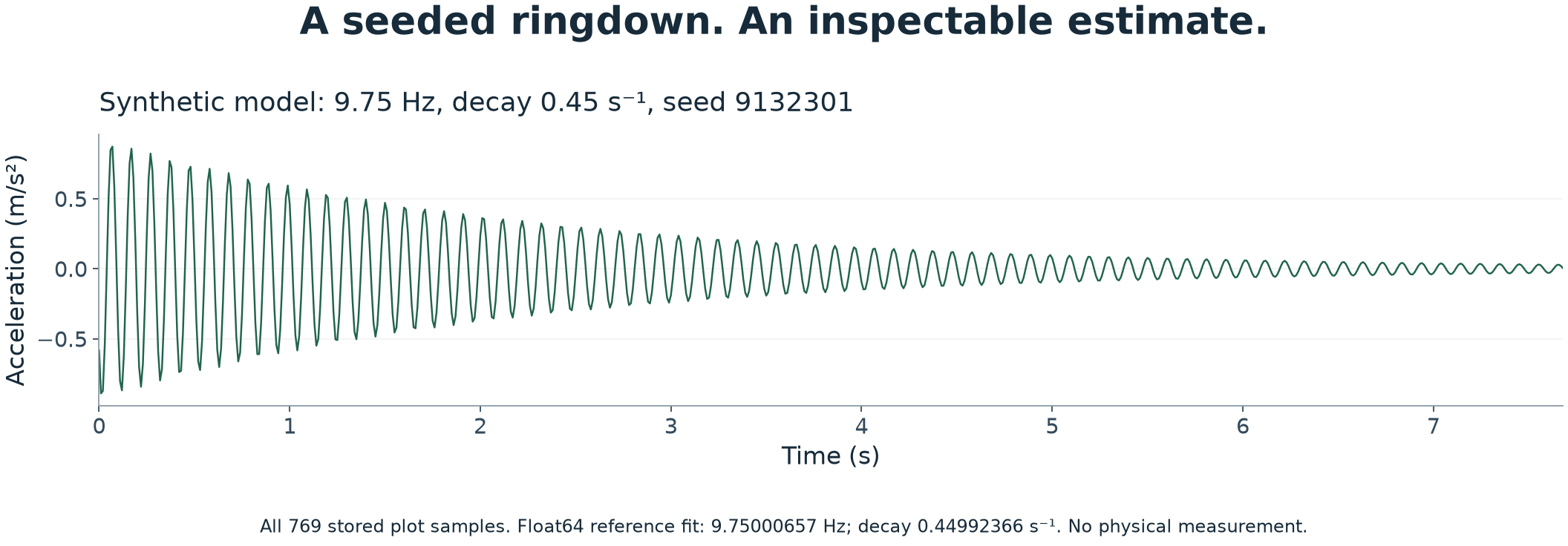
The retained custom ringdown contains 769 displayed acceleration samples. Its analytic model is 9.75 Hz with decay 0.45 s⁻¹ at seed 9132301. The stored numerical reference returns 9.750006565906396 Hz and decay 0.4499236618270089 s⁻¹ on the same captured input.
Foundations
The retained reference uses NumPy float64 processing and SciPy lfilter, distinguished from the recorded C-path results. The project’s external recordings and dependencies retain their own notices; none is relabeled as this synthetic capture.
Inspect the details
The portfolio figure displays stored time in seconds and acceleration in m/s². Connecting lines aid reading between samples and do not create additional observations.
The same retained JSON includes raw-host, calibrated-edge and filtered-edge C-path results, estimator diagnostics and source identity. It supports comparing processing paths without calling numerical agreement a hardware measurement.
Recorded evidence and limits · Project source
Recorded case source: c1a252300159e2e8e161db43191aafcbea701077