LadderProof
Find when a higher digital code produces a lower voltage, then choose resistor tolerances that prevent it.
Scope of this case
Exact results apply to the declared ideal static 2–6-bit circuit and independent resistor intervals. Catalog costs are synthetic units, not part prices; this is not measured hardware or manufacturing yield.
The problem
A digital-to-analog converter should increase its output as the input code increases. Resistor variation can reverse a step. Knowing the worst allowed step and which tolerances repair it turns a bad example into a design decision.
The mechanism
LadderProof enumerates every admitted corner of a small resistor-tolerance box using exact fractions. A nodal circuit solve finds the worst adjacent-code transition and attaining resistor assignment; a separate Thevenin-based verifier recomputes the complete bounds. A finite catalog search trades user-defined component costs against a required minimum step.
The observed result
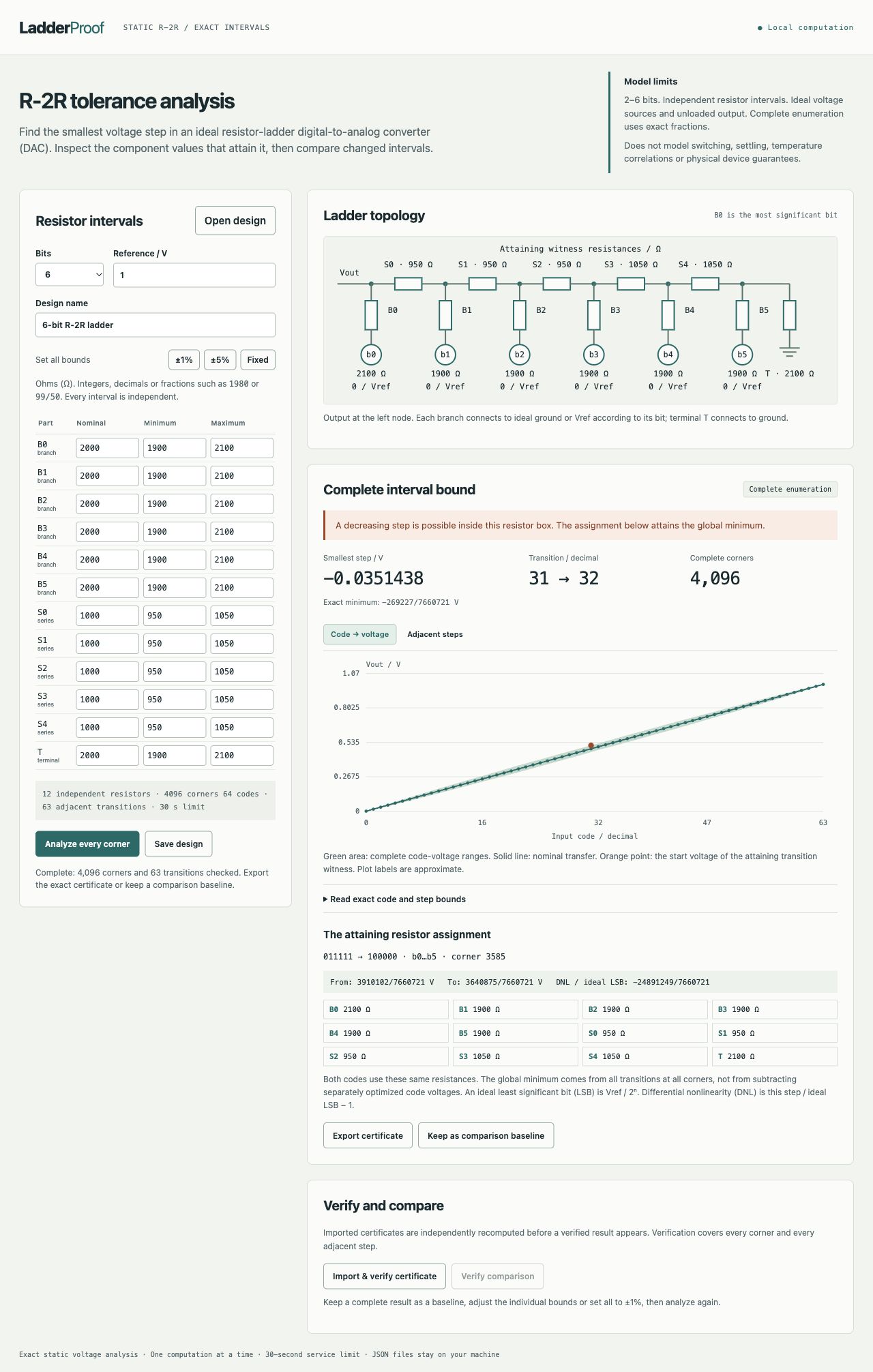
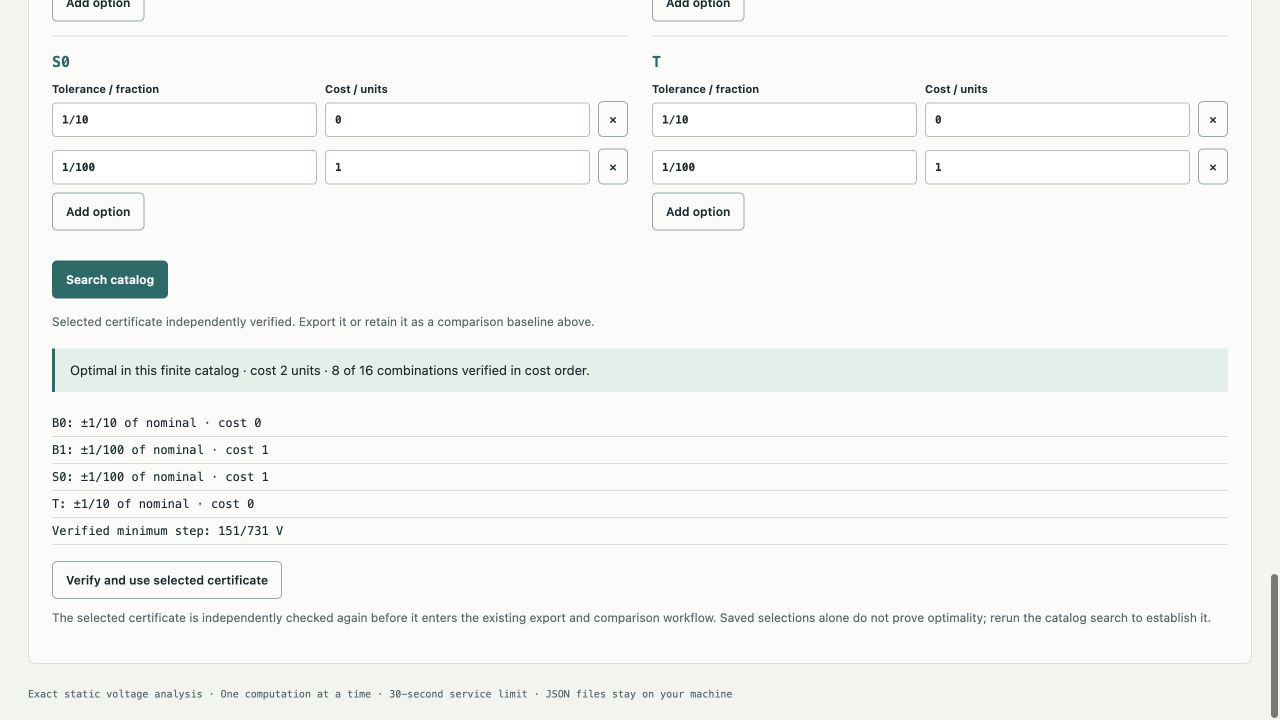
The included six-bit ±5% case decreases at code 31→32, while the ±1% case has no decreasing step across all 4,096 modeled corners. In the synthetic two-bit catalog, tightening B1 and S0 meets the 1/5 V requirement for cost 2 rather than cost 4 for every part. The chosen exact worst step is 151/731 V; the all-loose baseline is 68/409 V.
Foundations
Established R–2R circuit analysis and exact arithmetic, implemented as an inspectable bounded analyzer with a separate complete verifier. The project credits its model references and keeps its MIT license. It is not a SPICE replacement or an invention of the converter architecture.
Inspect the details
This case is pinned to the complete finite-catalog workflow at 12604d131498ba3851bea6a45066a0d1d71fa7c0, corresponding to actual approved V6 computation. Later ccb0d22ad1651390ae86283143f8b069bd7dc78b is a CSS-only V7 successor: narrow labels/focus were checked while JS, HTML and exact arithmetic stayed unchanged. This is not a new V7 worker computation run.
The retained workbench image originated at 67925bd3140d004164248f119aafcebd943644dd and remains unchanged in this workflow. Its exact minimum is −269227/7660721 V; the ±1% minimum is 186147971/34016602567 V. Verification re-enumerates every corner, not merely the displayed adverse assignment.
The recorded browser workflow exercised optimal selection, finite exhaustion/infeasibility, a work-limit stop, malformed exact-fraction recovery and independent Verify and use selection. The successful two-bit selection was independently recomputed over 16 corners and 3 adjacent transitions.
The model assumes ideal switches, a fixed positive reference and unloaded output. Independent intervals do not model matched/correlated resistor families. Switching glitches, settling, temperature, noise, reference regulation and physical yield are outside the result.
Search returns optimal only under its exact cost-order/verification conditions, infeasible after exhausting the admitted finite catalog, and unfinished when candidate/corner/deadline limits stop it. Arbitrary additive costs are not prices. Certificates are replayable computations, not succinct formal proofs or cryptographic attestations.
Keep the MIT license and docs/references.md context with redistributed material. Runtime uses Python standard-library exact arithmetic and local browser code; no account, paid service or hardware is needed.
Source, data and license notices
Recorded evidence and limits · Project source
Recorded case source: 12604d131498ba3851bea6a45066a0d1d71fa7c0