MaterialMind
Compare crystal stability predictions and active-learning query choices with archived computed reference data.
Scope of this case
One selected retrospective interval miss, not an uncertainty-coverage study or new DFT calculation. The fitted policy did not outperform adapted greedy in the released study. No synthesis, physical stability or official blind-benchmark claim.
The problem
A high query rank or confident stability score can hide an inaccurate energy prediction. The evidence needs to distinguish what the model knew before reveal from the archived reference it is compared against.
The mechanism
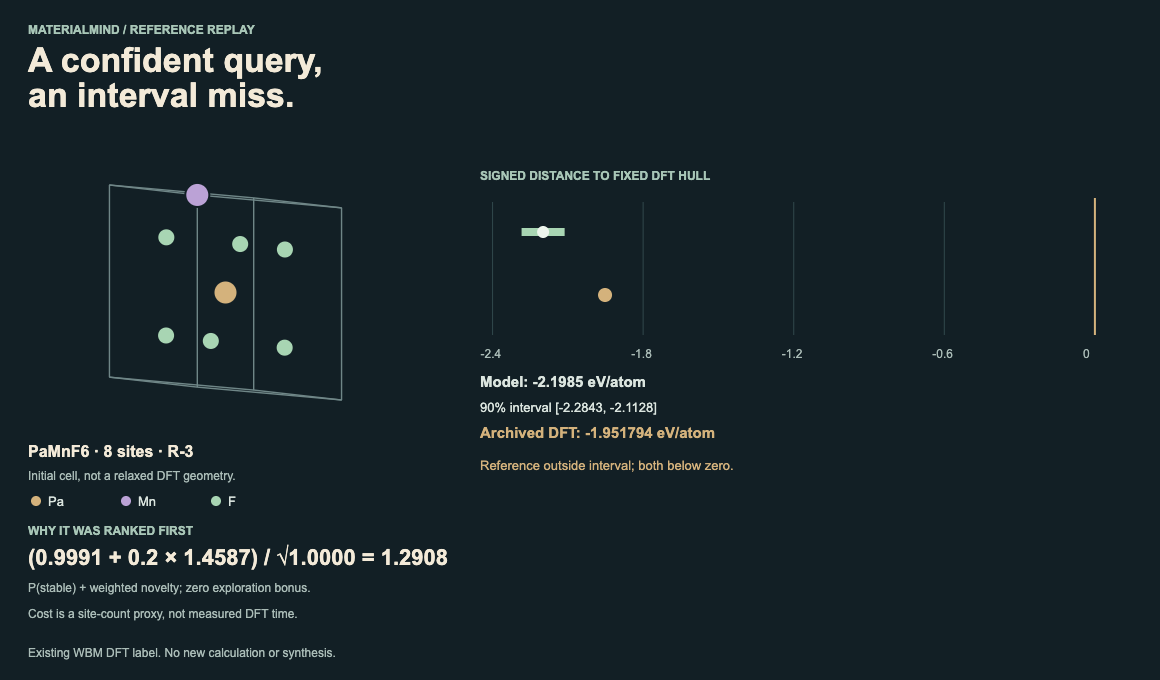
The workbench retains an initial crystal, its pre-reveal prediction and uncertainty, and the acquisition components used to choose a query. Revealing the existing DFT reference exposes that one selected energy lies outside the stated interval; it does not acquire a new physical measurement.
The observed result
PaMnF6 ranks first in this recorded query. Its pre-reveal energy estimate is −2.198549726666667 eV/atom, with a stated 90% interval from −2.284320417627142 to −2.1127790357061924. The archived reference is −1.951794 eV/atom, outside that interval. Both energies are below the fixed reference hull.
Foundations
Retained WBM/Matbench Discovery computed reference data, Janosh Riebesell and contributors, CC-BY-4.0; original WBM by Wang, Botti and Marques. Code MIT. Original data attribution and transformations stay with the case assets.
Inspect the details
The crystal view uses the retained lattice and eight atomic sites. It does not represent a synthesized specimen or predict a new structure.
Query rank, stability probability and energy-interval accuracy answer different questions. The source, raw values, native save/reopen evidence and negative aggregate result remain available in the owning repository.
Recorded evidence and limits · Project source
Recorded case source: c879afa4b616649cac73ef46b010f24e12ed3544