MorphProof
Find the input where a Python-to-Rust transformation changes the answer, then keep a replayable witness.
Scope of this case
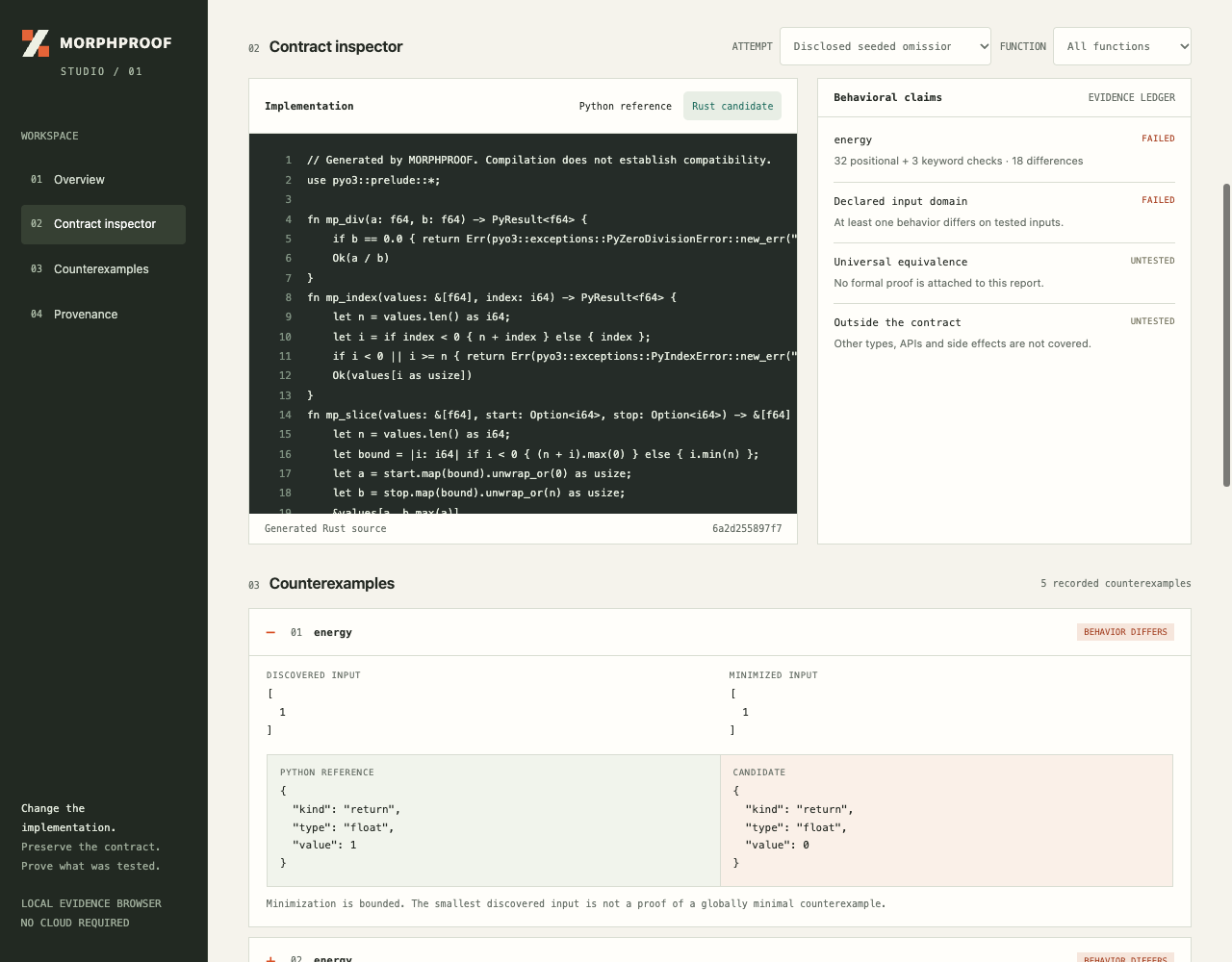
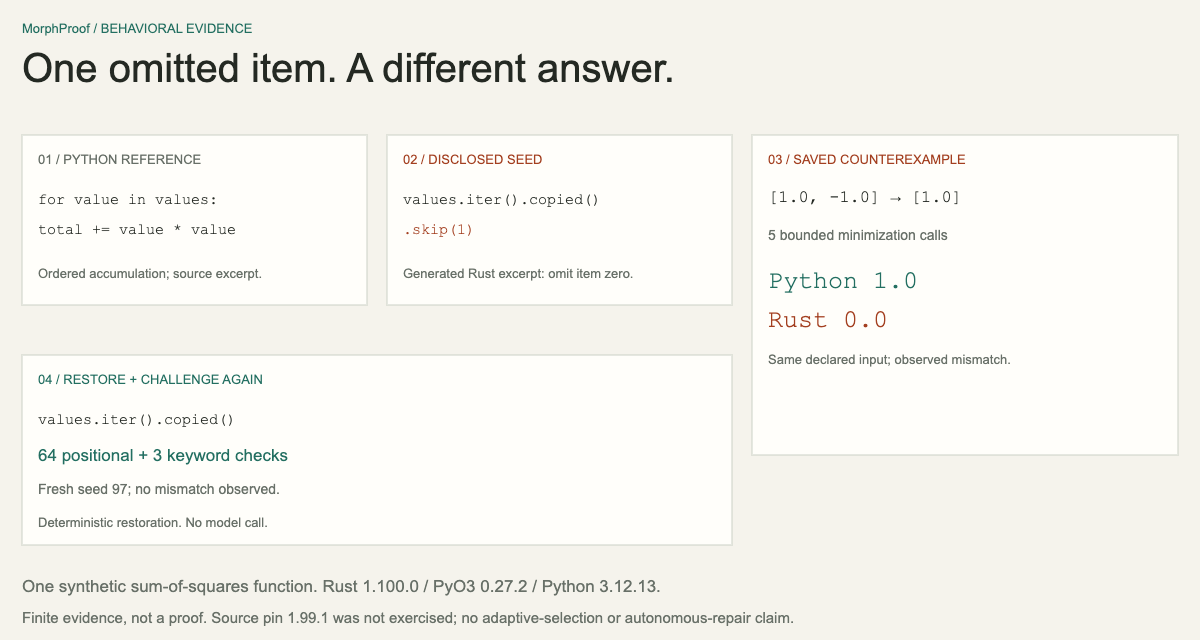
The loop omission is a disclosed seed and its restoration is deterministic. Finite comparisons do not prove universal equivalence; the portable Studio replays evidence rather than executing uploaded code.
The problem
A successful build does not show that rewritten code behaves the same way. A useful transformation workflow needs an explicit input contract, observable comparisons and a small case that explains any disagreement.
The mechanism
MorphProof compiles a bounded numerical Python subset into a Rust-backed package. Separate workers run reference and candidate under the declared contract; bounded minimization reduces a mismatch to a replayable input. The portable Studio puts source, tested inputs, observed differences and untested claims together, while the worked artifact retains native snapshots and notices.
The observed result
In the disclosed synthetic example, a deliberately inserted loop omission reduces [1.0, -1.0] to the witness [1.0]: Python returns 1.0 and Rust returns 0.0. Restoring the generated loop passes 64 fresh positional comparisons and 3 keyword checks. The native worked package reopens in a fresh Python 3.12 environment; newer native CI separately builds and imports packages on Linux, macOS ARM64 and Windows.
Foundations
Original MIT-licensed compiler, comparison workflow and evidence viewer, using Python, Rust, PyO3 0.27.2 and Maturin. Keep the worked artifact’s MIT license, dependency manifest and actual Cargo dependency notices. Separately attributed upstream experiment fixtures remain distinct from this one-function example.
Inspect the details
Current Studio/public source is 36208c6a6ed15ae62c62e73eb99076fd5c79286d. The original one-function native run used source 80a0daaf3eec332642159971ac33b8c59e3d0eaf, Rust/cargo 1.100.0, PyO3 0.27.2 and Python 3.12.13. The diagram first appeared at 399600c51eba4b14821f65517a8388f66495cbf9 and remains unchanged. Do not relabel its binary as a Rust 1.99.1 artifact.
Later current-source CI exercised Rust/cargo 1.99.1 on Linux, macOS ARM64 and Windows, including transformation, wheel build, installation and keyword import. This is separate evidence from the original witness, not a repeat of every historical timing or selector experiment.
The supported subset is pure deterministic numerical functions with one list[float] argument and float result. It handles declared keyword names, binary64 operation order, signed zero, infinity and NaN class as documented. Arbitrary repositories, NumPy objects and stateful code are outside the claim; unsupported syntax is refused.
Five bounded minimization calls found [1.0], not a proven globally smallest witness. Comparison budgets are not unique-input counts: each positional campaign contains 27 unique inputs. Passing the restored campaign is finite evidence, not autonomous repair or formal proof.
The Studio is a portable recorded evidence viewer. Exact retained native snapshots require macOS ARM64 and Python 3.12; other systems rebuild with an explicit toolchain. Its abi3 wheel tag does not establish every platform/interpreter combination. Worker separation isolates state/time, not filesystem access: execute trusted source only.
If redistributing native artifacts, preserve docs/presentation/LICENSE.txt, DEPENDENCIES.md, Cargo.lock files and the actual dependency notices. This portfolio links the intact worked package rather than stripping notices or copying its binaries. Separately attributed boltons/more_itertools research fixtures are not inputs to this case.
Source, data and license notices
Recorded evidence and limits · Project source
Recorded case source: 36208c6a6ed15ae62c62e73eb99076fd5c79286d