QLOOM
Compile a logical quantum circuit for a device graph, inspect the physical operations and mapping, and check that its meaning survives.
Scope of this case
This is one stored synthetic example with a two-candidate budget. No SWAP appears in this selected circuit. Numerical evidence is not a formal equivalence proof, a QPU execution or a claim that the learned policy beats established compilers.
The problem
A physical circuit must respect a device’s connectivity without silently changing the logical program. Gate count alone cannot show whether routing, placement and phase have been handled correctly.
The mechanism
QLOOM searches a bounded set of compiler strategies on a CPU. The Studio exposes the logical input, physical gates, logical-to-physical mapping, candidate costs and numerical verification. A trained policy ranks strategies, while explicit checks decide whether a candidate preserves the supported program’s meaning.
The observed result
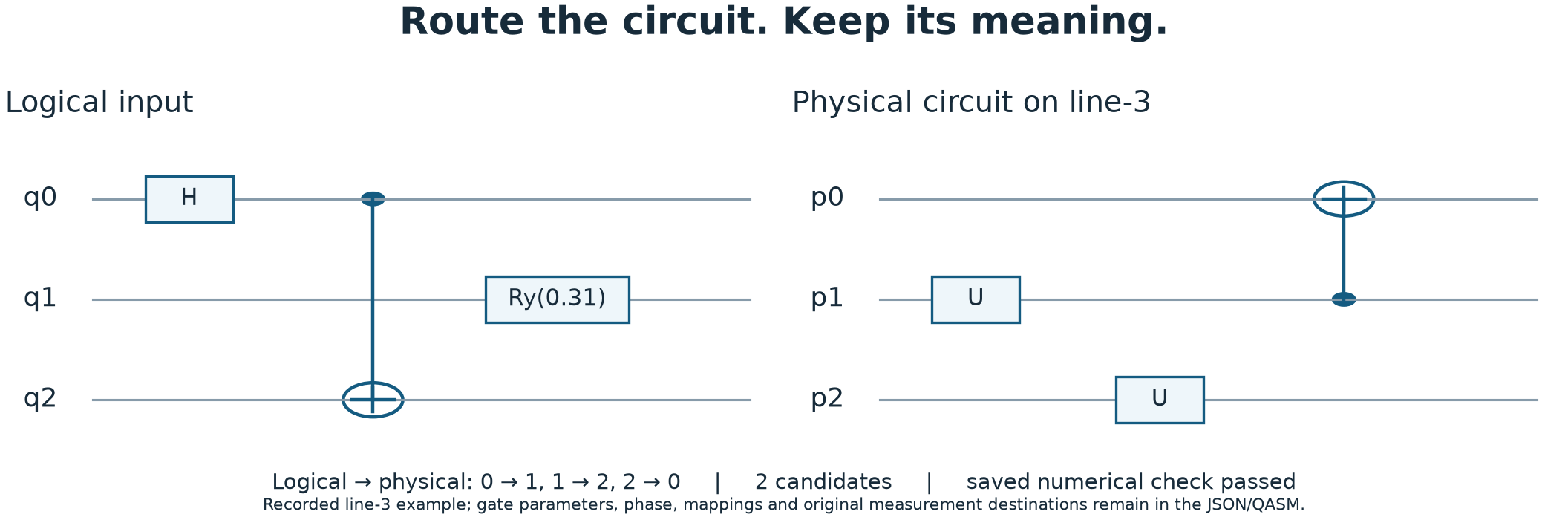
The retained three-qubit line-device example maps H(q0), CX(q0,q2) and Ry(0.31)(q1) to selected physical operations U(p1), U(p2) and CX(p1,p0). Initial and final mappings are [1, 2, 0]. The recorded maximum operator error is 1.401642967028923e-16 against tolerance 1e-8.
Foundations
Qiskit supplies circuit interchange and standard gate translation. QLOOM implements the selected layout/routing strategies; Qiskit levels, MQT QMAP and BQSKit are separately attributed comparison tools with their own licenses.
Inspect the details
The diagram reads the saved report rather than running a new compiler experiment. It must not be confused with the separate five-qubit, eight-candidate Studio demonstration.
The project’s measured study retains ties, failures and timeouts. It does not establish broad learned-policy superiority; the complete comparison belongs with its stated budgets and verification results.
Recorded evidence and limits · Project source
Recorded case source: ddcce9317bdc59e053f6b6fec3cedf43b9203111