SILICONPILOT
Turn a small neural classifier into inspectable hardware, then see what accuracy, area and latency cost.
Scope of this case
These are recorded simulations and FPGA-tool estimates, not board measurements. The pictured 0.1.0 corpus is preserved separately from the newer 0.1.1.dev0 compiler.
The problem
A neural model is only the start of a hardware design. Precision, multiplier reuse and scheduling change its answers, circuit size and speed. Those choices need visible arithmetic, generated hardware and comparable implementation evidence.
The mechanism
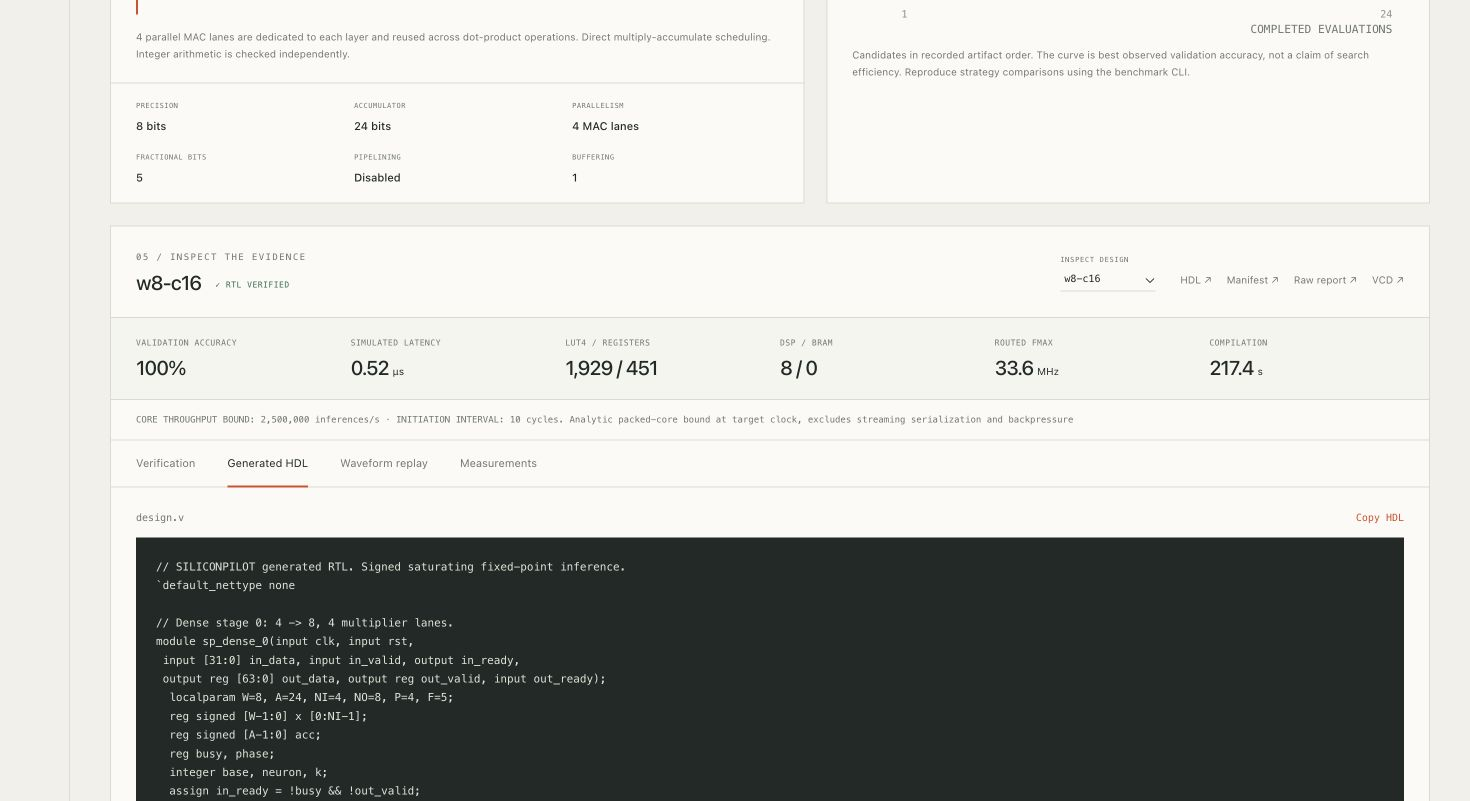
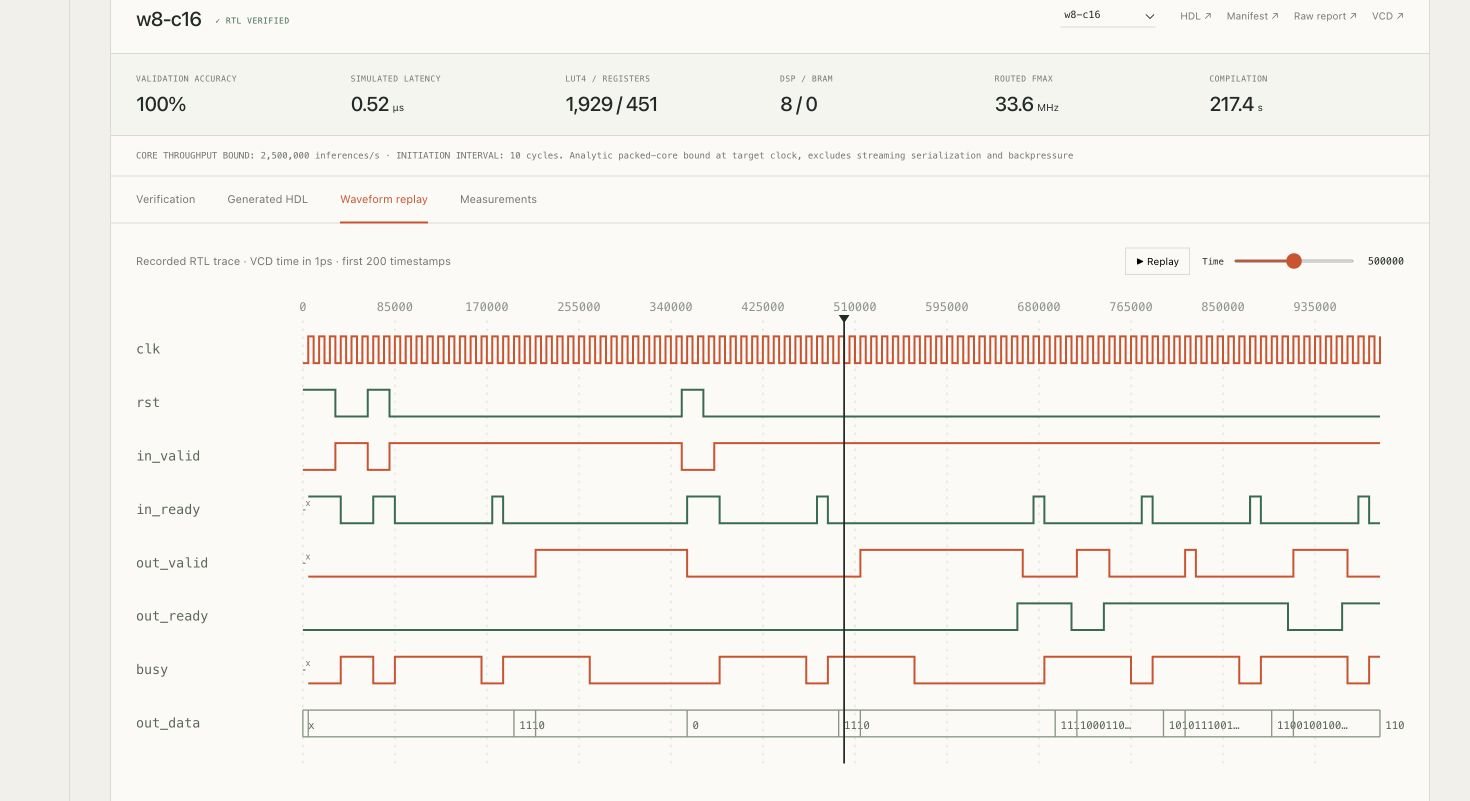
SILICONPILOT compiles fixed-shape dense/ReLU networks into signed fixed-point Verilog. An independent integer reference checks output bits and handshakes in RTL simulation; an open ECP5 synthesis and routing flow records implementation costs. The observatory connects each saved design to its source, waveform, resource report and tradeoff position.
The observed result
The recorded corpus contains 40 RTL-verified, synthesized and routed designs. In the demonstrated constraint change, a 1,929-LUT4 design has 0.52 microseconds of simulated core latency; a 1,170-LUT4 alternative has 2.00 microseconds. Both retain 100% accuracy on this validation split. A separate LUT-only mapped implementation matches the integer reference on 353 vectors.
Foundations
Original small RTL backend using established ML-to-FPGA and surrogate-search ideas. Icarus Verilog, Yosys and nextpnr supply simulation, synthesis and routing. Four precomputed input features come from Volker Lohweg’s UCI Banknote Authentication dataset (CC BY 4.0), not raw camera frames. Source is Apache-2.0; retain its license and upstream dataset/tool notices.
Inspect the details
The recorded case source pin is v0.1.0 at 61badd38086dc8c0395fff3dfd814f4073c90b93. Current source 6e2bbbe2faca1f10eb4a2a1e71a8aa858c56ffd1 identifies itself as 0.1.1.dev0. The online observatory is a static evidence browser; the separate local compiler action produces new RTL.
The current overlapped-products-v2 schedule reports 49 clocks to core output availability and a 34-clock sustained interval for the default packaged 4→8→2 model; two lanes with product pipelining report 27 and 19. These current modeled/simulation-checked values are not historical screenshot implementation costs. Recompiling an old configuration requires fresh synthesis and routing.
Core cycle latency excludes serial-shell transfers, stalls and board I/O. Fmax is a nextpnr estimate for the disclosed ECP5 device/constraint; pins are automatically assigned and external I/O delays unspecified. No physical FPGA was tested. Default DSP-mapped designs have a documented simulation-model limitation; the separate LUT-only mapped-netlist result does not validate every mapping.
Host preprocessing supplies four standardized wavelet features. Search uses validation rows; 100% validation is not test-population robustness or a deployed authentication result. UCI data attribution is Volker Lohweg, DOI 10.24432/C55P57, CC BY 4.0; the original source/provenance and changes remain documented.
The matched-budget finite replay does not show broad learned-search superiority: the fixed sweep recovers the full reference tradeoff volume and uses less compilation time on average. Cost uncertainty under-covers. Established compilers/search methods, including hls4ml, are credited in docs/research.md; this project does not invent hardware-aware optimization.
Source, data and license notices
Recorded evidence and limits · Project source
Recorded case source: 61badd38086dc8c0395fff3dfd814f4073c90b93