Solidrift
Shrink a native mesh Boolean failure while preserving the bug, then inspect a reversible geometry intervention and its source ancestry.
Scope of this case
The browser viewer replays stored geometry and never runs Blender. This is a bounded greedy reduction, not a globally smallest witness. The intervention changes the input geometry, not Blender’s implementation; agreement with MANIFOLD is not proof of an ideal union.
The problem
A Boolean union quietly drops part of the input. Sending the full model is easy; reducing it to a valid, small example that still reproduces the same failure is harder.
The mechanism
Solidrift contracts edges while checking that both operands remain valid closed solids and the same native failure survives. It tracks each vertex’s source ancestry, searches small boundary interventions on the witness, lifts a selected intervention back to the full inputs, and records native repair and undo results.
The observed result
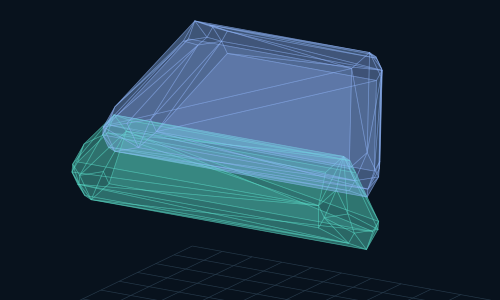
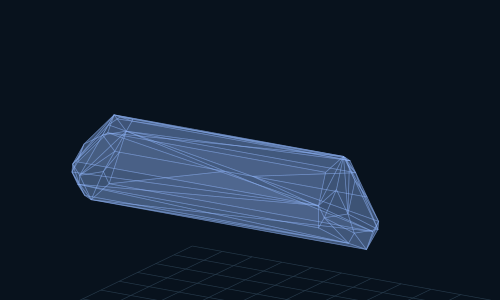
The retained investigation reduces 132 input triangles to a 12-triangle witness through 60 accepted contractions. Its recorded intervention moves three witness vertices whose ancestry covers thirteen original vertices. Undo restores the original input coordinates and the native omission. The two portfolio panels show the original 132-triangle stage, not the later witness.
Foundations
The two operands are Manifold regression fixtures under Apache-2.0, not original models. Blender supplies the FLOAT and MANIFOLD Boolean implementations. Solidrift’s implementation is MIT licensed, with fixture attribution retained.
Inspect the details
This case is tied to the retained Blender 5.3.0 Alpha build bad8871dc58d record at the cited source revision. Newer public investigations have separate backend identities and must not be merged into this older capture’s provenance.
The compact case bundles original identities, reduced and restored operands, contraction trace, coordinate patch, validity checks and backend identity. Intermediate input states can be replayed without inventing intermediate native output surfaces.
Recorded evidence and limits · Project source
Recorded case source: 8fc9e23471a18165d73646e290700cc10d351eea